A reliable power supply is the foundation of every ham radio station. Whether you’re operating a 5-watt QRP rig, a 100-watt HF transceiver, or a VHF/UHF base station, your radio depends on a stable source of clean 13.8-volt DC power. Choose the wrong power supply, and you may experience voltage drops, excessive fan noise, RF interference, or simply outgrow it as your station expands.
I’ve learned that many new amateur radio operators spend weeks researching transceivers and antennas, only to buy the cheapest power supply they can find. That’s usually a mistake. A quality power supply isn’t just another accessory—it’s the heart of your station. Every transmission, every digital mode contact, and every hour spent listening depends on it delivering consistent, reliable power.
Fortunately, there are excellent options available today. Modern switching power supplies are smaller, lighter, and quieter than ever before, while traditional linear power supplies continue to be the preferred choice for operators who want the lowest possible RF noise. The challenge isn’t finding a good power supply—it’s choosing the one that’s best suited to your operating style and equipment.
Table of Contents
In this guide, I’ll compare the best ham radio power supplies available today, explain the differences between switching and linear designs, show you how many amps your station really needs, and help you choose a model that will provide years of dependable service.
Quick Answer: What Is the Best Ham Radio Power Supply?
Samlex SEC-1235M Desktop 30A Switching Power Supply, Advanced…
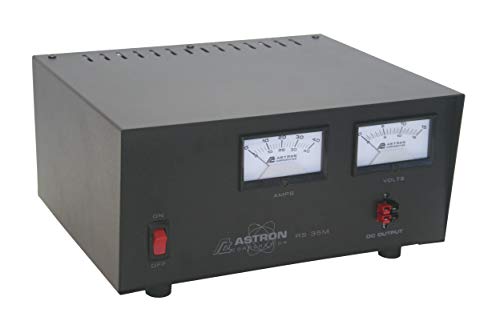
Astron 35 Amp Power Supply With Meters
Powerwerx SPS-30DM Variable 30 Amp Desktop DC Power Supply with…
If you’re looking for one power supply that suits most amateur radio stations, I recommend the Samlex SEC-1235M. It delivers a regulated 13.8 volts, provides 30 amps of continuous output (35 amps peak), runs quietly, and has earned an excellent reputation among amateur radio operators for reliability. It’s capable of powering virtually any modern 100-watt HF transceiver, while still leaving enough capacity for accessories such as an antenna tuner, external speaker, or digital interface.
For operators who place the highest priority on eliminating RF noise, the Astron RS-35A remains one of the finest linear power supplies ever built. Although it is considerably larger and heavier than modern switching supplies, many experienced operators continue to rely on Astron supplies because of their proven durability and exceptionally clean output.
If you’re just getting started in amateur radio, don’t assume you need the biggest power supply available. Most new operators are well served by a quality 30-amp regulated supply, which provides enough capacity for today’s popular 100-watt transceivers while allowing room for future station expansion.
The best choice ultimately depends on how you operate, your budget, and whether you prefer the compact efficiency of a modern switching supply or the near-silent performance of a traditional linear design.
Why Choosing the Right Power Supply Matters
When most people think about building a ham radio station, the radio itself gets all the attention. It’s easy to spend weeks comparing transceivers, antennas, microphones, and accessories while giving very little thought to the box that powers everything. In reality, your power supply is one of the hardest-working pieces of equipment in the shack.
Every time you key the microphone, your radio demands a large amount of current almost instantly. A typical 100-watt HF transceiver may draw more than 20 amps during transmission, yet only a fraction of that while receiving. A quality power supply handles these rapid changes effortlessly, maintaining a steady 13.8-volt output without significant voltage drop. A poorly designed or undersized supply, on the other hand, can cause reduced transmit power, distorted audio, unexpected radio resets, or premature equipment failure.
Power supplies also play an important role in overall receiver performance. Some inexpensive switching supplies generate electrical noise that can appear across the HF spectrum as unwanted birdies, buzzing, or hash. While modern switching designs from reputable manufacturers have become remarkably quiet, choosing a well-engineered model can make the difference between hearing a weak DX station and hearing only interference.
Reliability is another important consideration. Unlike many accessories that are only used occasionally, a power supply may remain switched on for hours every day. Many amateur operators still use Astron and Samlex supplies that have been powering stations reliably for twenty years or more. Buying a quality unit today often means you’ll never need to replace it.
Finally, it’s worth thinking about your future station rather than just your current one. Today you may own a single HF transceiver, but tomorrow you might add a VHF mobile radio, an antenna tuner, a sound-card interface for digital modes, an SDR receiver, or a Powerpole distribution panel. Choosing a power supply with a little extra capacity now can save both money and frustration later.
A dependable power supply isn’t the most exciting purchase you’ll make, but it may be the one that quietly serves your station the longest.
How Much Power Supply Do You Really Need?
One of the biggest mistakes new amateur radio operators make is buying a power supply that’s either far too small or much larger than they’ll ever need. The good news is that sizing a power supply is straightforward once you understand how your radio uses power.
Nearly all modern amateur radio transceivers are designed to operate from 13.8 volts DC, which closely matches the voltage provided by a fully charged 12-volt lead-acid battery. While the voltage requirement is relatively fixed, the amount of current your radio draws depends almost entirely on whether you’re receiving or transmitting.
During receive, most radios consume only one or two amps. The moment you press the push-to-talk button, however, current demand increases dramatically. A typical 100-watt HF transceiver can draw between 20 and 23 amps during full-power transmission, while smaller QRP radios often require less than five amps.
For that reason, you should always size your power supply based on the maximum transmit current, not the average current draw.
Recommended Power Supply Sizes
The following table provides a good starting point for selecting the right power supply.
Equipment
Typical Current Draw
Recommended Power Supply
QRP HF Radio (5–10 W)
2–5 A
10 A
25–50 W Mobile Radio
8–12 A
20 A
100 W HF Transceiver
20–23 A
30 A
HF Radio + Accessories
25–30 A
35 A
Two Radios or Larger Station
35–45 A
50 A or Larger
These recommendations provide a comfortable safety margin while allowing the power supply to operate well below its maximum capacity.
Why You Shouldn’t Run a Power Supply at Its Limit
Although it may be tempting to buy a power supply with a current rating that exactly matches your radio’s specifications, doing so leaves little room for unexpected loads or future expansion.
Electronic power supplies generally perform best when operating below their maximum continuous output. Running a 30-amp supply at 30 amps every time you transmit generates more heat, places additional stress on internal components, and may cause the cooling fan to run continuously. Over time, this can shorten the lifespan of the unit.
Instead, many experienced operators choose a supply with 20–30 percent additional capacity. That extra headroom allows the power supply to run cooler, regulate voltage more effectively during long transmissions, and accommodate accessories without approaching its limits.
Don’t Forget Your Accessories
Your transceiver probably won’t be the only device connected to your station’s DC power system. Depending on your setup, you may also power:
An automatic antenna tuner
External speaker
Digital mode interface
SDR receiver
Powerpole distribution panel
Station lighting
Cooling fans
Clock or frequency standard
Most of these devices consume relatively little current, but together they can add several additional amps to your station’s total load. Planning for future expansion now is often less expensive than replacing an undersized power supply later.
My Recommendation
For most amateur radio operators, a 30- to 35-amp regulated 13.8-volt power supply is the sweet spot.
It’s large enough to comfortably power popular 100-watt transceivers such as the Icom IC-7300, Yaesu FT-710, Yaesu FT-991A, and Kenwood TS-890S, while still providing reserve capacity for accessories you’ll likely add as your station grows.
Unless you’re operating multiple radios simultaneously or planning to add a linear amplifier that requires its own DC supply, there’s little reason for most home stations to purchase anything larger than a quality 35-amp unit.
Switching vs. Linear Power Supplies: Which Is Better?
One of the first decisions you’ll make when shopping for a ham radio power supply is whether to choose a switching or linear design. Both have their advantages, and the right choice depends on your operating style, available space, and budget.
Years ago, this decision was easy. Most experienced operators avoided switching power supplies because they generated significant RF interference across the HF bands. That reputation has lingered, but today’s high-quality switching supplies are a completely different story. Advances in filtering, circuit design, and manufacturing have made many modern switching supplies quiet enough for even serious HF operators.
Linear power supplies, however, still have a loyal following. Their simple design produces exceptionally clean DC power with virtually no switching noise, making them a favorite among contesters, DXers, and anyone who values the quietest possible receiver.
Switching Power Supplies
Modern switching supplies convert AC power at high frequencies before regulating it to a stable 13.8-volt output. This design allows them to be much smaller and lighter than traditional linear supplies while operating more efficiently.
For most amateur radio operators, a quality switching supply is the most practical choice.
Advantages
Lightweight and compact
High electrical efficiency
Produce less heat
Excellent voltage regulation
Usually less expensive for comparable output
Ideal for portable and desktop stations
Disadvantages
Cheap models may generate RF interference
Cooling fans can become audible during heavy use
Internal circuitry is generally more complex
Fortunately, the RF noise problems that plagued early switching supplies are largely confined to inexpensive, off-brand units. Well-designed models from companies like Samlex, Alinco, and Powerwerx perform exceptionally well on the amateur bands.
Linear Power Supplies
Linear power supplies use a large transformer to reduce household AC voltage before converting it to clean DC power. The design has changed very little over the past several decades because it simply works.
The biggest downside is weight. A 35-amp linear power supply can easily weigh 25 pounds (11 kg) or more, making it considerably less portable than an equivalent switching supply.
Advantages
Extremely low RF noise
Proven long-term reliability
Simple, rugged construction
Excellent for sensitive HF operation
Often repairable if something eventually fails
Disadvantages
Large and heavy
Less energy efficient
Generate more heat
Usually more expensive to ship because of their weight
The Astron RS series has become almost legendary in amateur radio. Many operators continue using Astron supplies that were purchased twenty or thirty years ago, and it’s not unusual to find one still powering a station after decades of daily use.
Side-by-Side Comparison
Feature
Switching Power Supply
Linear Power Supply
Weight
Very light
Heavy
Size
Compact
Large
Efficiency
Excellent
Moderate
Heat Output
Low
Higher
RF Noise
Very low on quality models
Virtually none
Portability
Excellent
Poor
Price
Usually lower
Usually higher
Long-Term Reliability
Excellent
Outstanding
Which Should You Buy?
For most amateur radio operators, I recommend a quality switching power supply. Models from Samlex, Alinco, Powerwerx, and other reputable manufacturers provide excellent performance, are easy to fit into a crowded shack, and offer more than enough current for today’s 100-watt transceivers.
If your primary interests are weak-signal HF work, DX chasing, contesting, or you simply appreciate equipment built like a tank, a quality linear supply such as the Astron RS-35A remains an outstanding investment.
The important point isn’t whether the supply is switching or linear—it’s whether it’s well designed. A high-quality switching supply will almost always outperform a poorly built linear supply, and vice versa. Rather than focusing solely on the technology, choose a model from a manufacturer with a proven reputation in the amateur radio community.
The Best Ham Radio Power Supplies
After comparing dozens of models and looking at what experienced amateur radio operators actually use, these are the power supplies I recommend with confidence. Each one has earned a solid reputation for reliability, stable voltage regulation, and dependable performance in real-world ham radio stations.
While there are plenty of inexpensive generic power supplies available online, I’ve focused on products from manufacturers with proven track records in the amateur radio community. A quality power supply is something you’ll likely own for many years, so it’s worth investing in a model that has demonstrated long-term reliability.
1. Samlex SEC-1235M — Best Overall Ham Radio Power Supply
The Samlex SEC-1235M is the power supply I would recommend to most amateur radio operators. It strikes an excellent balance between performance, reliability, size, and price, making it suitable for everything from a first HF station to an experienced operator’s primary shack.
Unlike many inexpensive switching supplies, the SEC-1235M is designed specifically with radio communications in mind. It offers excellent voltage regulation, low ripple, and very low RF noise, making it suitable for HF, VHF, and UHF operation.
With 30 amps of continuous output and 35 amps peak, it easily powers today’s popular 100-watt transceivers, including the Icom IC-7300, Yaesu FT-710, FT-991A, Kenwood TS-590SG, and similar radios.
Circuit innovations minimize output voltage ripple and RFI
Input voltage can be set at 120VAC or 240VAC (internal jumper)
UL listed to both USA & Canadian safety standards
Specifications
Specification
Value
Output Voltage
13.8 V DC
Continuous Output
30 A
Peak Output
35 A
Type
Switching
Cooling
Temperature-controlled fan
Meter
Analog Volt/Amp
Weight
Approximately 6 lbs (2.7 kg)
Pros
Excellent RF noise performance
Compact and lightweight
Reliable voltage regulation
Proven long-term durability
Easily powers any modern 100-watt transceiver
Excellent value for the money
Cons
Cooling fan can become noticeable under heavy loads
Analog meters may not appeal to everyone
My Verdict
If someone asked me to recommend one power supply without knowing anything about their station, this would probably be it. It’s powerful enough for nearly every amateur radio operator, compact enough for almost any desk, and backed by Samlex’s excellent reputation.
Best For: Most amateur radio operators.
2. Astron RS-35A — Best Linear Power Supply
If there’s a legendary name in amateur radio power supplies, it’s Astron. The RS-35A has been a staple of ham shacks for decades and continues to be one of the most respected linear power supplies available.
Unlike modern switching supplies, the RS-35A uses a traditional transformer-based design that produces exceptionally clean DC power with virtually no switching noise. That’s one reason many contesters, DXers, and weak-signal operators continue to favor Astron supplies.
The downside is obvious the moment you lift one. It’s significantly larger and heavier than an equivalent switching supply, but that’s the price you pay for its rugged construction and linear design.
Fold-Back Current Limiting – Protects from excessive current & continuous shorted output
Crowbar over voltage protection
Maintains regulation & low ripple at low line input voltage
Heavy duty heat sink with chassis mount fuse
Specifications
Specification
Value
Output Voltage
13.8 V DC
Continuous Output
25 A
ICS Rating
35 A
Type
Linear
Cooling
Passive
Meter
None (RS-35M includes meters)
Weight
Approximately 24 lbs (11 kg)
Pros
Virtually no RF interference
Exceptionally reliable
Heavy-duty transformer construction
Fanless operation
Easy to service if repairs are ever needed
Proven track record spanning decades
Cons
Heavy
Larger footprint
Less efficient than switching supplies
My Verdict
If your priority is the quietest possible receiver and a power supply that may outlast several radios, it’s difficult to beat the Astron RS-35A. It’s old-school engineering at its finest.
Best For: Serious HF operators and anyone who prefers a traditional linear supply.
3. Alinco DM-330MVT — Best Premium Switching Power Supply
The Alinco DM-330MVT is one of the most feature-rich switching power supplies available for amateur radio operators. It combines excellent electrical performance with conveniences that many operators appreciate, including adjustable output voltage, digital metering, and multiple output connections.
One of its standout features is the ability to adjust the output voltage over a wide range. While most hams will leave it set at 13.8 volts, the flexibility can be useful when powering accessories or testing equipment on the workbench.
The front panel is also well laid out, with clearly visible digital voltage and current displays that make it easy to monitor your station while operating.
Specifications
Specification
Value
Output Voltage
Adjustable
Continuous Output
30 A
Peak Output
32 A
Type
Switching
Cooling
Variable-speed fan
Meter
Digital
Pros
Bright digital display
Adjustable voltage
Quiet operation
Excellent voltage regulation
Compact design
Multiple front-panel outputs
Cons
More expensive than many competitors
Additional features may be unnecessary for some operators
My Verdict
If you appreciate modern features and want more than a basic bench supply, the Alinco DM-330MVT is an excellent choice. It combines professional performance with the convenience of digital monitoring and flexible output options.
Best For: Operators who want premium features and digital metering.
I agree. Five quality recommendations are stronger than eight mediocre ones, especially since we want to recommend products that are readily available on Amazon.com.
I’d use this lineup:
Samlex SEC-1235M — Best Overall
Astron RS-35A — Best Linear
Alinco DM-330MVT — Best Premium
Pyramid PS-36KX — Best Budget
Powerwerx SS-30DV — Best for Amateur Radio
That covers every buyer type without filler.
4. Pyramid PS-36KX — Best Budget Ham Radio Power Supply
If you’re building your first ham radio station or simply want a dependable power supply without spending a lot of money, the Pyramid PS-36KX is an excellent value. It has been a popular entry-level choice for years and is widely available through Amazon and amateur radio retailers.
The PS-36KX provides enough power for most 100-watt transceivers while including features typically found on more expensive models, such as front-panel binding posts, cigarette lighter socket, and adjustable voltage output. While it doesn’t have the premium build quality of Samlex or Astron supplies, it performs well for everyday amateur radio use.
Like many budget switching supplies, the cooling fan can become noticeable during extended transmissions, but most operators find it perfectly acceptable for casual operating, digital modes, and general station use.
Specifications
Specification
Value
Output Voltage
9–15 V DC Adjustable
Continuous Output
30 A
Peak Output
36 A
Type
Switching
Cooling
Fan Cooled
Meter
Analog
Pros
Very affordable
Powers most 100-watt transceivers
Adjustable output voltage
Multiple front-panel outputs
Easy to find on Amazon
Cons
Build quality isn’t as refined as premium brands
Fan noise is more noticeable under heavy load
Analog meters are basic
My Verdict
The Pyramid PS-36KX is ideal for new hams who want a capable power supply without making a large investment. If your budget allows, I’d still choose the Samlex, but the Pyramid offers excellent value and will serve many stations well.
Best For: Beginners and budget-conscious operators.
5. Powerwerx SS-30DV — Best for Amateur Radio Operators
The Powerwerx SS-30DV was designed specifically with amateur radio operators in mind. Unlike many general-purpose bench supplies, it includes features that make it especially convenient in a ham shack, including front-mounted Anderson Powerpole connectors and multiple DC output options.
Powerwerx has built an excellent reputation for high-quality DC power accessories, and the SS-30DV reflects that experience. It delivers clean, regulated 13.8-volt output with very low ripple, making it suitable for HF, VHF, and UHF operation. Its compact size also makes it a good choice for operators with limited desk space.
One feature I particularly like is the built-in Powerpole output. If your station already uses Anderson Powerpole connectors—and many modern ham stations do—you can connect equipment directly without adapters or custom wiring.
Features user adjustable 5~16 VDC variable output or fixed 14.1 VDC output
Rear power output via 1/4″ binding posts
Supplies up to 25 amps continuous, 28 amps surge
Specifications
Specification
Value
Output Voltage
13.8 V DC
Continuous Output
30 A
Peak Output
35 A
Type
Switching
Cooling
Temperature-Controlled Fan
Meter
Digital Voltage and Current Display
Pros
Built-in Anderson Powerpole outputs
Compact design
Excellent voltage regulation
Very low RF noise
High-quality construction
Designed specifically for amateur radio
Cons
More expensive than entry-level supplies
Availability can occasionally be limited
My Verdict
If your station already uses Anderson Powerpole connectors or you’re planning to standardize your DC wiring, the Powerwerx SS-30DV is one of the most convenient power supplies you can buy. Its combination of clean power, compact size, and ham-friendly features makes it an easy recommendation.
Best For: Operators building a modern, Powerpole-equipped ham radio station.
How to Calculate Your Station’s Power Requirements
Walk readers through a simple example.
Suppose you’re running an Icom IC-7300, which draws approximately 21 amps at full transmit power. Add a few amps for an antenna tuner, a Signalink interface, and a small SDR receiver, and your station may require around 25 amps. Rather than buying a 25-amp supply, it’s better to choose a 30- or 35-amp model so it isn’t operating at its limit during every transmission.
Include a small table:
Equipment
Current Draw
IC-7300
21 A
FT-710
22 A
FT-991A
23 A
IC-705
2 A
Xiegu G90
8 A
Features Worth Paying For
Instead of just listing specifications, explain why they matter.
Discuss:
Adjustable output voltage
Digital vs. analog meters
Temperature-controlled cooling fans
Short-circuit protection
Over-voltage protection
Front-panel DC terminals
Anderson Powerpole outputs
Binding posts
Remote sensing (if available)
Common Mistakes When Buying a Ham Radio Power Supply
This is great EEAT content because it’s based on experience.
Cover things like:
Buying solely on peak current instead of continuous current.
Purchasing the cheapest no-name switching supply.
Forgetting future expansion.
Running the supply at 100% output continuously.
Using undersized DC wiring.
Poor ventilation around the power supply.
Ignoring RF noise specifications.
Frequently Asked Questions
Aim for 8–10 questions.
Examples:
What size power supply do I need for a 100-watt ham radio?
Is a switching power supply good for HF?
Are linear power supplies better?
Why do ham radios use 13.8 volts?
Can I use a computer power supply?
Can one power supply run two radios?
How long should a power supply last?
What happens if my power supply is too small?
These often generate featured snippets.
Final Verdict
Don’t just repeat the reviews. Guide the reader.
For example:
If you want…
Buy…
The best overall
Samlex SEC-1235M
The quietest operation
Astron RS-35A
Premium features
Alinco DM-330MVT
Best value
Pyramid PS-36KX
Powerpole convenience
Powerwerx SS-30DV
Features to Look for in a Ham Radio Power Supply
Not all ham radio power supplies are created equal. While every model in this guide provides regulated 13.8-volt DC power, the features they offer can have a significant impact on day-to-day operation. Understanding what these features do will help you choose a power supply that matches both your current station and your future plans.
Continuous vs. Peak Current Ratings
One of the first specifications you’ll notice is the current rating. Unfortunately, some manufacturers advertise the peak output because it’s a larger, more impressive number.
For amateur radio, the continuous current rating is the one that matters.
A power supply may be capable of delivering 35 amps for a few seconds during a heavy load, but if its continuous rating is only 25 amps, that’s the figure you should use when sizing it for your station.
Whenever possible, choose a power supply with enough continuous capacity that it isn’t operating at its maximum output every time you transmit.
Voltage Regulation
Modern amateur radios are designed to operate at approximately 13.8 volts DC. A quality power supply should maintain that voltage whether you’re listening quietly or transmitting at full power.
Poor voltage regulation can cause reduced transmitter output, unstable operation, or unexpected radio resets during high-power transmissions.
Every power supply recommended in this guide uses regulated output to provide a stable voltage under changing load conditions.
RF Noise Performance
For HF operators, this may be the single most important specification.
Some inexpensive switching power supplies generate electrical noise that appears across the amateur bands as buzzing, whining, or birdies. That interference can make weak stations difficult to hear and reduce overall receiver performance.
Fortunately, today’s premium switching supplies have improved dramatically. Manufacturers such as Samlex, Alinco, and Powerwerx use filtering and shielding that greatly reduce the possibility of RF interference.
If your primary interest is weak-signal DXing or contesting, a high-quality linear power supply remains the quietest option available.
Cooling System
Every power supply generates heat, especially during long transmissions or digital mode operation.
Most switching supplies use thermostatically controlled cooling fans that only increase in speed when additional cooling is needed. This keeps the power supply quieter during normal operation while providing adequate airflow under heavy loads.
Linear power supplies often rely on large heat sinks instead of fans, making them virtually silent but considerably heavier.
Safety Protection
A quality power supply should include multiple layers of protection to safeguard both itself and your radio.
Look for features such as:
Over-voltage protection
Over-current protection
Short-circuit protection
Thermal overload protection
Automatic shutdown during fault conditions
These features help prevent expensive damage if wiring mistakes or equipment failures occur.
Front-Panel Connections
Convenient front-panel connections make everyday operation much easier.
Many amateur radio power supplies include:
Binding posts
Banana jack outputs
Anderson Powerpole connectors
Cigarette lighter socket
USB charging ports on some models
If you frequently connect test equipment or portable radios, these front-panel outputs can save time and reduce wear on the primary terminals.
Digital vs. Analog Meters
Most power supplies include some way of monitoring voltage and current.
Analog meters are simple, reliable, and easy to read from across the room. Digital displays offer greater precision and often provide additional information, such as current draw while transmitting.
Neither option is inherently better. The choice comes down to personal preference, and both perform the same essential function.
Build Quality
A ham radio power supply is one piece of equipment that often remains in service for decades. Solid construction, quality components, and good thermal design generally matter far more than extra features or flashy displays.
A well-built power supply from a reputable manufacturer may outlast several transceivers, making it one of the best long-term investments you can make for your station.
Common Mistakes to Avoid When Buying a Ham Radio Power Supply
A power supply may not be the most exciting purchase for your ham radio station, but choosing the wrong one can lead to years of frustration. Fortunately, most mistakes are easy to avoid once you know what to look for.
Buying Based on Peak Current Instead of Continuous Current
One of the most common mistakes is comparing power supplies by their advertised peak current rating.
Peak current is the maximum output a power supply can deliver for a very short period of time. Continuous current is what it can safely provide all day without overheating or reducing performance.
For example, a power supply advertised as 35 amps peak may only be capable of supplying 30 amps continuously. If your radio requires 22 amps while transmitting, the continuous rating is the number that matters.
Whenever you’re comparing models, ignore the marketing headline and look for the continuous output specification.
Buying the Cheapest Power Supply Available
It can be tempting to save money by purchasing an inexpensive, no-name power supply online. While some budget models perform surprisingly well, others suffer from poor voltage regulation, excessive fan noise, or inadequate RF filtering.
A noisy power supply can raise your receiver’s noise floor, making weak stations harder to hear and reducing overall enjoyment of the hobby.
Spending a little more on a well-known brand often results in better reliability, cleaner output, and a power supply that lasts for many years.
Buying Too Small
Many new operators purchase a power supply that’s just large enough to power their first radio.
That works initially, but stations rarely stay the same for long. Accessories such as antenna tuners, digital mode interfaces, SDR receivers, powered speakers, and Powerpole distribution panels all increase the total current requirement.
Choosing a supply with a modest amount of extra capacity gives you room to expand without needing another upgrade later.
Ignoring Ventilation
Every power supply generates heat.
Switching supplies rely on internal fans, while linear supplies dissipate heat through large heat sinks. In either case, airflow is essential.
Avoid placing a power supply inside a tightly enclosed cabinet or stacking equipment directly on top of it. Providing several inches of clearance around the ventilation openings helps keep internal temperatures lower and extends the life of the components.
Using Undersized Power Cables
A high-quality power supply can’t compensate for poor wiring.
Long cable runs or undersized wire can cause voltage drop between the power supply and the radio, reducing transmitter performance and generating unnecessary heat.
For most 100-watt HF transceivers, 12 AWG or 10 AWG stranded copper wire is an excellent choice, especially if the cable run is more than a few feet.
Always protect DC wiring with appropriately sized fuses located as close to the power source as practical.
Forgetting About Future Expansion
Your first ham radio station is rarely your last.
Many operators eventually add a second transceiver, an SDR receiver, an automatic antenna tuner, packet radio equipment, or other accessories. Purchasing a quality 30- or 35-amp power supply from the beginning often eliminates the need to replace it as your station grows.
Think of your power supply as a long-term investment rather than a temporary accessory. A good one may still be powering your station twenty years from now.
Frequently Asked Questions
What size power supply do I need for a 100-watt ham radio?
Most modern 100-watt HF transceivers draw between 20 and 23 amps when transmitting at full power. A regulated 30-amp or 35-amp power supply provides enough capacity to operate the radio comfortably while leaving room for accessories such as an antenna tuner, digital interface, or external speaker.
Is a switching power supply good for ham radio?
Yes. Modern switching power supplies from reputable manufacturers such as Samlex, Alinco, and Powerwerx are designed with excellent voltage regulation and RF filtering. While inexpensive no-name models may generate interference, quality switching supplies perform very well on HF, VHF, and UHF bands.
Are linear power supplies better than switching power supplies?
Not necessarily. Linear power supplies produce exceptionally clean DC power and virtually no switching noise, making them popular with serious HF operators. However, they’re also much larger, heavier, and less efficient.
For most amateur radio stations, a high-quality switching power supply offers the best combination of performance, size, and value.
Why do ham radios use 13.8 volts instead of 12 volts?
Although they’re commonly referred to as 12-volt radios, most amateur transceivers are actually designed to operate at approximately 13.8 volts DC. This matches the output of a fully charged lead-acid battery and the charging systems used in most vehicles.
Regulated power supplies maintain this voltage to ensure consistent transmitter output and reliable operation.
Can I use a computer power supply for my ham radio?
Some amateur radio operators modify ATX computer power supplies for radio use, and they can work well in certain situations. However, they often require modifications before they’ll operate without a computer motherboard, and some models may generate RF noise.
A purpose-built amateur radio power supply is generally the simpler and more reliable choice.
Can one power supply run multiple radios?
Yes, provided it has sufficient current capacity.
If the combined transmit current of all connected equipment remains below the continuous current rating of the power supply, a single supply can safely power multiple radios and accessories. Many operators use a Powerpole distribution panel to connect several devices to one power supply.
How long should a ham radio power supply last?
A quality power supply from a reputable manufacturer can remain in service for decades with minimal maintenance. It’s common to find Astron, Samlex, and other well-built supplies that have been powering amateur radio stations for twenty years or more.
Keeping the unit clean, well ventilated, and operating below its maximum continuous output can help maximize its lifespan.
What’s the best overall ham radio power supply?
For most amateur radio operators, I recommend the Samlex SEC-1235M. It delivers clean, regulated 13.8-volt power, provides ample current for today’s 100-watt transceivers, operates quietly, and has earned an outstanding reputation for reliability.
Its combination of performance, compact size, and long-term durability makes it an excellent choice for both new and experienced amateur radio operators.
Finally…
Choosing the right power supply isn’t just about finding one with the highest current rating. It’s about selecting a model that provides clean, reliable power today while giving your station room to grow in the future.
For most operators, the Samlex SEC-1235M offers the best overall combination of performance, reliability, and value. It has enough capacity to power virtually any modern 100-watt HF transceiver, runs quietly, and has earned the trust of amateur radio operators around the world.
If absolute RF quietness is your highest priority, the Astron RS-35A remains one of the finest linear power supplies ever built. Its rugged construction and proven reliability have made it a fixture in ham shacks for decades.
Operators looking for premium features will appreciate the Alinco DM-330MVT, while newcomers to the hobby can save money without sacrificing essential performance by choosing the Pyramid PS-36KX. If your station is built around Anderson Powerpole connectors, the Powerwerx SS-30DV is an outstanding option designed specifically for amateur radio use.
No matter which model you choose, buy a power supply with enough continuous current for your equipment, leave room for future expansion, and stick with a manufacturer that has a proven reputation in the amateur radio community. A quality power supply is one of the few pieces of station equipment that can realistically serve you for decades, making it one of the smartest long-term investments you’ll make in your ham radio shack.
Rick Blythe [VE3CNU] is a licensed amateur radio operator and founder of Radio-Hobbyist, with decades of experience, sharing expert guidance on SDR, ham radio, shortwave, scanners, and antennas. At Radio-Hobbyist, we combine practical radio experience with technical research and carefully developed guides to help readers understand radio technology, choose equipment, and get more from their hobby.