Parks on the Air (POTA) has become a favorite of many to enjoy amateur radio. Instead of operating from a fixed station, one can pack a radio, battery, antenna, and a few accessories into a backpack, head to a nearby park, and be on the air within minutes. Whether chasing DX, making casual contacts, or activating a new park, portable operating adds an element of adventure that simply isn’t possible from the shack.
Choosing the right portable HF radio, however, isn’t as straightforward as buying the smallest transceiver you can find. Weight certainly matters when you’re hiking to a remote operating location, but so do receiver performance, battery consumption, operating ergonomics, weather resistance, and output power. A radio that performs brilliantly on the bench may become frustrating after several hours of field use if the display is difficult to read in sunlight or the controls are awkward while wearing gloves.
I’ve found that every POTA operator eventually develops their own priorities. Some activators value the smallest and lightest equipment possible, accepting lower power output in exchange for portability. Others prefer carrying a slightly heavier 100-watt radio because the extra power can make difficult contacts much easier, especially when band conditions are poor. There isn’t a single “best” radio for everyone, but there are several outstanding choices depending on how and where you operate.
In this guide, I’ll compare today’s best portable HF transceivers for Parks on the Air, looking beyond marketing specifications to evaluate the features that actually matter in the field. We’ll compare weight, receiver quality, power output, battery efficiency, portability, and overall value so you can confidently choose the right radio for your style of portable operating.
What Makes a Great Portable HF Radio for POTA?
Not every HF transceiver is well suited for portable operation. Many excellent base station radios become cumbersome once you add an external power supply, tuner, and carrying case. On the other hand, some compact QRP radios sacrifice features that become valuable during longer activations.
After years of watching activators in the field and evaluating today’s most popular portable rigs, I believe several characteristics separate an excellent POTA radio from an average one.

Weight and Portability
The first consideration is obvious: how much gear are you willing to carry?
If you’re operating from a vehicle or setting up at a picnic shelter only a short walk from the parking lot, an eight-pound radio may not seem excessive. If you’re hiking several kilometers into a state or provincial park with a backpack full of equipment, every pound quickly becomes noticeable.
It’s important to remember that the radio is only part of your load. You’ll also be carrying a battery, antenna, mast, coaxial cable, headphones, logging device, and various accessories. Saving even two pounds on the transceiver can significantly improve comfort during a long hike.
Power Output
Portable operators often debate whether QRP or 100 watts is the better choice.
Five to ten watts can produce remarkable results with an efficient antenna and favorable propagation. Many experienced activators routinely complete successful POTA activations using only QRP equipment. However, lower power generally requires better operating skills, patience, and favorable band conditions.
A 100-watt transceiver offers a much larger operating margin. When propagation deteriorates or local noise levels increase, the additional power often makes the difference between struggling for contacts and completing an activation quickly.
Neither approach is inherently better. Your preferred operating style will largely determine which power level makes the most sense.
Receiver Performance
One of the most overlooked characteristics of a portable radio is receiver quality.
Parks can present surprisingly challenging RF environments. Nearby power lines, visitor electronics, switching power supplies, and strong broadcast stations may all contribute to interference. A receiver with excellent dynamic range, effective filtering, and low internal noise makes weak stations much easier to copy.
Modern DSP filtering, adjustable noise reduction, and notch filters are particularly valuable when operating crowded bands during popular POTA weekends.
Battery Efficiency
Battery capacity directly affects how long you can remain on the air.
Current consumption varies dramatically between radios, particularly during receive operation. A transceiver that draws only a few hundred milliamps while listening may operate for several additional hours compared to a less efficient design using the same battery.
For activators planning multiple parks in a single day, efficient power management can be just as important as transmitter output power.
Ease of Operation
Portable operating places different demands on a radio than operating from a home station.
Controls should be easy to access outdoors, even while standing or sitting at a picnic table. Displays should remain readable in bright sunlight, menus should be intuitive, and commonly used adjustments such as RF gain, filtering, and mode selection should require minimal navigation.
After several hours in the field, small ergonomic improvements become surprisingly important.
Built-In Features
Integrated features can reduce both pack weight and setup time.
Useful features include:
- Internal antenna tuner
- Built-in sound card for digital modes
- GPS receiver
- Bluetooth or Wi-Fi connectivity
- Internal battery
- Spectrum scope
- Waterfall display
- USB CAT control
While none of these are strictly necessary, they can simplify portable operation and eliminate the need for additional accessories.
Best POTA Radios at a Glance
Radio | Output Power | Weight | Internal Battery | Internal ATU | Best For |
|---|---|---|---|---|---|
Icom IC-705 | 10 W | 2.4 lb (1.1 kg) | ✔ | Optional | Best Overall |
Yaesu FT-891 | 100 W | 4.2 lb (1.9 kg) | ✘ | ✘ | Best 100-Watt Value |
Xiegu G90 | 20 W | 3.7 lb (1.7 kg) | ✘ | ✔ | Best Value |
Elecraft KX2 | 10 W | 1.3 lb (0.6 kg) | ✔ | ✔ | Best Backpack Radio |
Elecraft KX3 | 15 W | 1.6 lb (0.7 kg) | Optional | Optional | Best Premium QRP |
Lab599 TX-500 | 10 W | 1.2 lb (0.55 kg) | ✘ | ✘ | Best Rugged Design |
Yaesu FT-710 Field | 100 W | 9.9 lb (4.5 kg) | ✘ | ✔ | Best Portable Base Station |
Xiegu X6200 | 8–10 W | 2.2 lb (1.0 kg) | ✔ | ✔ | Best All-in-One Portable |
Best Overall Portable HF Radio for POTA: Icom IC-705
If I could own only one radio specifically for Parks on the Air, the Icom IC-705 would be my choice. It strikes an outstanding balance between portability, receiver performance, modern features, and ease of use. While it isn’t inexpensive, it’s one of the few radios that feels purpose-built for portable operating rather than being a downsized mobile transceiver.
At just over two pounds, the IC-705 is light enough to carry comfortably on long hikes yet offers features normally found on much larger base station radios. The large color touchscreen, built-in GPS, Wi-Fi, Bluetooth, and excellent spectrum scope make it a pleasure to use in the field. For operators who enjoy digital modes, the integrated USB sound card and CAT control simplify laptop connections without requiring additional interfaces.
The receiver is another standout feature. Based on technology from Icom’s larger SDR transceivers, it delivers excellent sensitivity, strong adjacent-signal rejection, and an intuitive waterfall display that makes finding active frequencies remarkably easy. During busy weekends when POTA activity is high, being able to visualize the band saves time and makes hunting for contacts much more enjoyable.
The biggest limitation is transmitter power. The IC-705 produces 5 watts using its internal battery and 10 watts when powered from an external 13.8-volt supply. Under good propagation conditions, that is usually enough for successful activations, but operators accustomed to 100 watts will notice the difference when conditions deteriorate.

- Output Power: 10W with 13.8VDC external power supply, 5W with BP-272 li-ion battery pack
- Receiver: 0.030–199.999, 400.000–470.000
- Transmitter…
- The large 4.3-inch touch screen color improves visibility and operability in the field.
- Built-in Bluetooth and wireless LAN; use for smartphone linking and remote control
Pros
- Outstanding SDR receiver
- Bright, easy-to-read touchscreen
- Excellent waterfall and spectrum scope
- Built-in GPS, Bluetooth, and Wi-Fi
- Integrated USB sound card
- Compact and lightweight
- Excellent support for digital modes
Cons
- Premium price
- No internal antenna tuner
- Limited to 10 watts with external power
- Internal battery provides only 5 watts
Best For
Operators who want the most capable all-around portable HF transceiver with modern SDR features and excellent receiver performance.
Why I Recommend It
The IC-705 isn’t the smallest or the most powerful radio on this list, but it offers the best overall operating experience. Every aspect of the radio—from the display to the receiver and user interface—feels refined. If your budget allows, it’s difficult to find another portable radio that combines so many features in such a compact package.
Specification | Icom IC-705 |
|---|---|
HF/6 m | Yes |
VHF/UHF | Yes |
Output Power | 5–10 W |
Weight | 2.4 lb (1.1 kg) |
Internal Battery | Yes |
Internal Tuner | No |
Digital Modes | Excellent |
Best Feature | SDR Receiver & Touchscreen |
Best 100-Watt Portable Radio: Yaesu FT-891
While many portable operators gravitate toward lightweight QRP rigs, there are times when nothing beats having a full 100 watts available. That’s where the Yaesu FT-891 shines. It has become one of the most popular radios among serious POTA activators because it delivers full-power HF performance in a surprisingly compact package.
The FT-891 isn’t an SDR radio, nor does it offer a color touchscreen or built-in waterfall. Instead, Yaesu focused on receiver performance and ruggedness. The result is a traditional superheterodyne transceiver with an excellent reputation for pulling weak signals out of crowded bands.
The radio weighs just over four pounds, making it manageable for most portable setups, especially if you’re activating close to your vehicle. Pair it with a lightweight LiFePO₄ battery and a resonant antenna, and you’ll have a station capable of working stations across North America—and often around the world—with relative ease.
Its biggest drawback is the menu system. Many operators find it less intuitive than modern touchscreen radios, particularly during their first few outings. Once you’ve learned where the commonly used functions are located, however, operation becomes second nature.
Another consideration is the lack of an internal antenna tuner. You’ll either need resonant antennas or an external tuner if you plan to use multiple wire antennas.

- Yaesu FT-891 HF/6M Mobile Transceiver, All Mode, 100 Watts
- HAM Guides Quick Reference Card Included
Pros
- Full 100-watt output
- Excellent receiver
- Compact for a mobile-class transceiver
- Proven reliability
- Outstanding value
Cons
- No internal tuner
- Menu system takes time to learn
- No spectrum scope
- Requires external battery
Best For
Operators who want maximum signal strength while keeping equipment reasonably portable.
Why I Recommend It
If your goal is making contacts quickly and reliably, especially during poor band conditions, it’s hard to beat 100 watts. The FT-891 has earned its reputation because it consistently performs well in the field without costing as much as many flagship HF transceivers.
Specification | Yaesu FT-891 |
|---|---|
HF/6 m | Yes |
Output Power | 100 W |
Weight | 4.2 lb (1.9 kg) |
Internal Battery | No |
Internal Tuner | No |
Digital Modes | Good |
Best Feature | Full Power in a Compact Package |
Best Value Portable HF Radio: Xiegu G90
Not everyone wants to spend over $1,000 on a portable HF transceiver, and fortunately, you don’t have to. The Xiegu G90 has become one of the best values in amateur radio by offering an impressive combination of features at a much lower price than many competitors.
The G90 delivers 20 watts of output power, providing a useful middle ground between QRP radios and full 100-watt transceivers. That additional power often makes a noticeable difference during POTA activations, especially when propagation is only average.
One feature that sets the G90 apart is its excellent built-in automatic antenna tuner. It has an unusually wide tuning range and is capable of matching antennas that many other internal tuners simply cannot. For portable operators experimenting with end-fed wires or improvised antennas, this flexibility is a significant advantage.
The receiver performs well for its price point, although it doesn’t quite match the refinement of premium radios from Icom or Elecraft. The display is functional, and the spectrum scope is useful, but the user interface can occasionally feel less polished.
Despite these compromises, the G90 continues to attract a loyal following because it offers exceptional value. It’s a radio that lets newcomers enjoy successful POTA activations without exhausting their equipment budget.

- High Performance SDR – The XIEGU G90 is a portable 20W amateur shortwave transceiver built on an SDR…
- Versatile Mode Options – This device supports SSB, CW, and AM operating modes, Allowing users to…
- High-Definition Display – Featuring a 1.8-inch high-brightness color TFT LCD screen, The XIEGU G…
- User-Friendly Design – The detachable control head design allows for easy positioning of the main…
- Outstanding Support – Ham Club Only provides Xiegu products, With Xiegu professional technicians to…
Pros
- Outstanding value
- 20-watt output
- Excellent internal antenna tuner
- Good receiver
- Compact size
Cons
- Heavier than some QRP radios
- Interface isn’t as polished as premium models
- External battery required
Best For
Budget-conscious operators who want more than QRP power without investing in a premium transceiver.
Why I Recommend It
The G90 occupies a unique position in today’s market. It provides enough power to noticeably improve portable operating while remaining compact, affordable, and easy to pack. For many new POTA operators, it represents the best balance between performance and cost.
Specification | Xiegu G90 |
|---|---|
HF/6 m | Yes |
Output Power | 20 W |
Weight | 3.7 lb (1.7 kg) |
Internal Battery | No |
Internal Tuner | Yes |
Digital Modes | Good |
Best Feature | Excellent Value & Built-in ATU |
Best Ultralight Backpack Radio: Elecraft KX2
If minimizing weight is your highest priority, it’s difficult to beat the Elecraft KX2. Designed from the ground up for backpack portable operation, the KX2 has become a favorite among hikers, Summits on the Air (SOTA) enthusiasts, and minimalist POTA activators who want the lightest possible station without sacrificing performance.
Weighing just over a pound, the KX2 almost disappears into a backpack. Even after adding a compact battery, microphone, and lightweight end-fed antenna, the entire station can weigh less than many standalone mobile transceivers.
Don’t let its size fool you. The receiver is exceptionally good, with excellent filtering, low internal noise, and impressive dynamic range. Weak stations remain easy to copy even when strong signals are nearby, making the KX2 an excellent choice for crowded weekends.
One of its biggest advantages is the availability of both an internal battery and an optional internal automatic antenna tuner. That means you can arrive at a park, throw a wire into a tree, connect the antenna, and begin operating within minutes. Fewer external accessories also mean fewer cables to manage and fewer things to forget at home.
The primary limitation is transmitter power. At 10 watts, the KX2 is firmly in the QRP category. While experienced operators regularly complete successful activations with this output, newcomers may find challenging propagation conditions more frustrating than they would with a higher-power radio.
Pros
- Extremely lightweight
- Outstanding receiver performance
- Internal battery available
- Excellent internal automatic tuner
- Outstanding battery efficiency
- Superb CW performance
Cons
- Premium price
- No VHF or UHF coverage
- Small display
- QRP output only
Best For
Backpack activators who prioritize the lightest possible station while maintaining excellent HF performance.
Why I Recommend It
The KX2 was clearly designed by operators who spend time in the field. Every feature emphasizes portability, efficiency, and simplicity. If hiking several miles to a remote operating location is part of your POTA routine, few radios can match what the KX2 offers.
Specification | Elecraft KX2 |
|---|---|
HF Bands | Yes |
Output Power | 10 W |
Weight | 1.3 lb (0.6 kg) |
Internal Battery | Yes |
Internal Tuner | Yes |
Digital Modes | Good |
Best Feature | Ultralight Backpack Design |
Best Premium QRP Radio: Elecraft KX3
Although it’s been on the market for several years, the Elecraft KX3 remains one of the finest portable HF transceivers ever produced. It has earned a reputation for receiver performance that rivals many full-sized desktop radios while remaining remarkably compact.
Compared to the KX2, the KX3 offers a larger display, additional controls, broader operating flexibility, and optional 2-meter coverage. Many serious DXers and contest operators continue to use the KX3 because of its exceptional receiver characteristics.
The modular design allows operators to configure the radio according to their needs. Internal batteries, automatic antenna tuner, roofing filters, and optional accessories let you tailor the radio for lightweight backpacking or more demanding portable expeditions.
Its age is perhaps its only real weakness. Unlike newer SDR radios, the KX3 lacks an integrated spectrum waterfall and modern touchscreen interface. Nevertheless, the receiver remains one of the best available in any portable transceiver.
Pros
- Outstanding receiver
- Modular design
- Optional internal tuner
- Excellent battery efficiency
- Proven reliability
- Excellent CW performance
Cons
- Expensive
- Older interface design
- Options increase total cost
- Waterfall requires external display
Best For
Experienced operators who value receiver performance above flashy features.
Why I Recommend It
The KX3 continues to prove that great receiver engineering never goes out of style. Even after years on the market, it remains one of the most respected portable HF radios available.
Specification | Elecraft KX3 |
|---|---|
HF/6 m | Yes |
Output Power | 15 W |
Weight | 1.6 lb (0.7 kg) |
Internal Battery | Optional |
Internal Tuner | Optional |
Digital Modes | Excellent |
Best Feature | Exceptional Receiver |
Best Rugged Portable Radio: Lab599 TX-500
For operators who routinely activate parks in harsh weather or challenging environments, the Lab599 TX-500 offers something few competitors can match: exceptional durability.
Unlike most amateur transceivers, the TX-500 was designed with outdoor operation as a primary goal. Its sealed aluminum chassis resists dust and moisture far better than conventional radios, making it an excellent companion for camping trips, backcountry expeditions, and winter activations.
The low-profile design also packs efficiently into a backpack. Without protruding knobs or fragile controls, the radio feels more like professional field equipment than consumer electronics.
Performance is equally impressive. The receiver is quiet and sensitive, the display remains readable outdoors, and the controls are simple enough to operate with gloves. Although it lacks an internal tuner and internal battery, many operators consider that an acceptable compromise for the added ruggedness.
Pros
- Extremely rugged construction
- Lightweight aluminum chassis
- Excellent receiver
- Outdoor-friendly controls
- Low power consumption
Cons
- No internal tuner
- No internal battery
- Limited availability
- Premium price
Best For
Operators who frequently activate parks in challenging weather or rugged terrain.
Why I Recommend It
If reliability is your highest priority, the TX-500 deserves serious consideration. It’s one of the few portable HF radios that feels built specifically for outdoor adventure rather than occasional field use.
Specification | Lab599 TX-500 |
|---|---|
HF Bands | Yes |
Output Power | 10 W |
Weight | 1.2 lb (0.55 kg) |
Internal Battery | No |
Internal Tuner | No |
Digital Modes | Excellent |
Best Feature | Rugged Weather-Resistant Design |
Best Portable 100-Watt Base Station: Yaesu FT-710 Field
Not every POTA activation requires hiking deep into the woods. Many operators set up close to their vehicle, allowing them to bring larger equipment that offers better ergonomics and more operating power.
For these situations, the Yaesu FT-710 Field is an outstanding choice.
Although considerably heavier than the other radios in this guide, the FT-710 delivers excellent receiver performance, a large color display, real-time spectrum scope, built-in automatic tuner, and full 100-watt output. In many respects, it provides nearly everything you would expect from a modern home station while remaining compact enough to transport easily.
Its receiver has received widespread praise for handling crowded bands and weak signals exceptionally well. During busy contests or popular POTA weekends, the filtering and DSP capabilities help separate stations that would otherwise be difficult to copy.
Naturally, the radio’s weight makes it unsuitable for backpacking, but for drive-up activations, RV trips, and portable field stations, it performs exceptionally well.
Pros
- Excellent SDR receiver
- Full 100-watt output
- Built-in antenna tuner
- Large color display
- Excellent spectrum scope
- Outstanding DSP filtering
Cons
- Too heavy for backpacking
- Requires larger battery
- Higher current consumption
Best For
Vehicle-supported activations where performance takes priority over portability.
Why I Recommend It
If you’re operating from a picnic shelter a short distance from your vehicle, there’s little reason to compromise. The FT-710 delivers near-base-station performance while remaining transportable enough for portable operating.
Specification | Yaesu FT-710 Field |
|---|---|
HF/6 m | Yes |
Output Power | 100 W |
Weight | 9.9 lb (4.5 kg) |
Internal Battery | No |
Internal Tuner | Yes |
Digital Modes | Excellent |
Best Feature | Portable Base Station Performance |
Best All-in-One Portable Radio: Xiegu X6200
The Xiegu X6200 is one of the newest entrants in the portable HF market and attempts to combine many of the features operators appreciate in the IC-705 with a more affordable price point.
It includes an internal battery, automatic antenna tuner, SDR architecture, color touchscreen, spectrum display, and support for digital modes in a compact package. For operators who prefer carrying a single self-contained radio, this is an attractive combination.
As with many newer designs, firmware updates continue to improve performance and expand functionality. While it may not yet match the refinement of long-established premium radios, it represents an impressive amount of capability for the price.
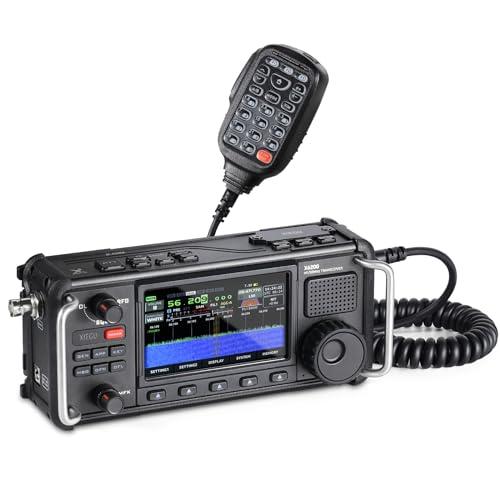
- Precision RF Direct Sampling: Transform your communication with our advanced RF Direct Sampling…
- Versatile Radio Operation: The X6200 supports a wide range of communication modes, including SSB…
- Portable Design: The Xiegu X6200 features a compact frame, a built-in replaceable 3200mAh battery…
- Advanced User Interface: Featuring a 4-inch high-resolution color screen paired with a sensitive…
- Automatic Antenna Tuner: The built-in automatic antenna tuner ensures optimal signal reception and…
Pros
- Internal battery
- Internal antenna tuner
- Color touchscreen
- SDR receiver
- Excellent feature set
- Good value
Cons
- Firmware continues to evolve
- Receiver not quite at premium level
- Smaller user community
Best For
Operators who want an affordable all-in-one portable SDR radio.
Why I Recommend It
The X6200 packs an impressive list of features into a lightweight package. For newcomers who want a modern SDR experience without stretching to the price of an IC-705, it’s an appealing alternative.
Specification | Xiegu X6200 |
|---|---|
HF/6 m | Yes |
Output Power | 8–10 W |
Weight | 2.2 lb (1.0 kg) |
Internal Battery | Yes |
Internal Tuner | Yes |
Digital Modes | Excellent |
Best Feature | Complete Portable Package |
QRP vs. 100 Watts: Which Is Better for POTA?
One of the first decisions every new POTA activator faces is whether to buy a lightweight QRP radio or a full-power 100-watt transceiver. I’ve operated with both, and each has advantages depending on how you like to activate parks.
The truth is that neither option is universally better. Your choice should depend on your operating style, how far you hike, the types of antennas you use, and how much equipment you’re willing to carry.
Why Many Activators Love QRP
There’s something incredibly satisfying about making contacts around the world using just a few watts. Modern receivers, efficient antennas, and improving propagation tools have made QRP more practical than ever.
The biggest advantage is portability. A complete QRP station—including the radio, battery, antenna, coax, and accessories—can often weigh less than six pounds. That’s a huge benefit if you’re hiking several kilometers into a national or provincial park.
QRP radios also consume far less current than 100-watt rigs. A modest LiFePO₄ battery can easily provide several hours of operating time, allowing you to activate multiple parks without carrying a heavy spare battery.
Many experienced operators also enjoy the challenge. Every contact feels a little more rewarding when you know it was made with only five or ten watts.
Where 100 Watts Makes Life Easier
While QRP is rewarding, there are days when additional power makes a dramatic difference.
Poor solar conditions, summer static, crowded bands, or compromised antennas can make it difficult for weaker signals to be heard. In those situations, 100 watts often means fewer repeats, shorter pileups, and quicker activations.
The difference becomes especially noticeable when calling CQ. A stronger signal generally attracts more callers, helping you reach the ten-contact minimum for a valid POTA activation much faster.
Higher power also gives you more flexibility with less-than-perfect antennas. If your portable antenna isn’t ideally placed or propagation suddenly changes, having additional power provides a useful safety margin.
The trade-off, of course, is increased weight. A 100-watt radio requires a significantly larger battery, and that extra battery weight is often greater than the difference between the radios themselves.
Which Should You Choose?
For most new POTA operators, I recommend thinking about how you travel to your operating location, not simply how much power you want.
If you’re hiking any significant distance, a lightweight QRP radio like the IC-705, Elecraft KX2, or Xiegu X6200 makes excellent sense. You’ll appreciate the reduced weight every step of the way.
If you’re operating from your vehicle or only carrying equipment a short distance, a 100-watt radio like the Yaesu FT-891 offers a much larger operating margin with relatively few drawbacks.
QRP vs. 100-Watt Comparison
Feature | QRP Radio | 100-Watt Radio |
|---|---|---|
Weight | ★★★★★ | ★★☆☆☆ |
Battery Life | ★★★★★ | ★★☆☆☆ |
Hiking | Excellent | Fair |
Weak Signal Performance | Good | Excellent |
Poor Band Conditions | Fair | Excellent |
Setup Weight | Very Light | Moderate to Heavy |
Operating Challenge | Higher | Lower |
Beginner Friendly | Moderate | Excellent |
Choosing the Right Battery for POTA
Your battery is every bit as important as your radio. A poor battery choice can shorten your operating time, increase the weight of your pack, and even reduce transmitter performance.
Fortunately, modern LiFePO₄ (Lithium Iron Phosphate) batteries have become the preferred choice for most portable HF operators.
LiFePO₄ Batteries
For POTA, this is my recommendation.
Compared to traditional sealed lead-acid batteries, LiFePO₄ batteries offer several advantages:
- Much lighter weight
- Higher usable capacity
- Stable voltage during discharge
- Long service life
- Faster charging
- Safer chemistry than many lithium-ion batteries
Although they cost more initially, their long lifespan usually makes them the better long-term investment.
How Much Capacity Do You Need?
The ideal battery size depends on your radio and operating style.
Radio Type | Suggested Battery |
|---|---|
5–10 W QRP | 4–6 Ah LiFePO₄ |
20 W Radio | 6–10 Ah LiFePO₄ |
100 W Radio | 15–20 Ah LiFePO₄ |
If you expect to activate multiple parks in one day, carrying a second smaller battery is often more convenient than carrying one very large battery.
Essential Accessories for a Successful POTA Activation
The radio is only one part of a successful portable station. A few carefully chosen accessories can make setup faster, improve operating efficiency, and reduce frustration in the field.
Portable Antenna
A high-quality antenna will usually improve your results more than buying a more expensive radio.
Popular choices include:
- End-fed half-wave antennas
- Linked dipoles
- Vertical antennas
- Telescoping fiberglass mast systems
Lightweight Mast
A 20- to 30-foot fiberglass telescoping mast provides enough height for most portable wire antennas while remaining easy to carry.
Quality Coax
Using lightweight, low-loss coax keeps pack weight manageable without sacrificing performance.
Throw Line
Getting your antenna into a tree quickly becomes much easier with a throw weight and line.
Headphones
Parks aren’t always quiet. Headphones improve weak-signal copy while reducing distractions from nearby visitors.
Logging Device
Whether you prefer a notebook, tablet, smartphone, or laptop, having an efficient logging method speeds up activations and reduces the chance of errors.
NanoVNA
A compact antenna analyzer allows you to verify resonance and troubleshoot antenna issues before getting on the air.
SWR Meter
Although many modern radios include SWR indication, an external meter is still useful when testing antennas or troubleshooting feed lines.
Frequently Asked Questions
Is 5 watts enough for POTA?
Yes. Thousands of successful POTA activations are completed every year using five to ten watts. Success depends largely on propagation, antenna efficiency, and operating skill.
Is the Icom IC-705 worth the extra money?
If you value portability, an excellent receiver, modern SDR features, and digital-mode capability, the IC-705 is one of the best portable radios available. Its premium price reflects its extensive feature set.
Can I use my home station radio for POTA?
Absolutely. Many operators activate parks using larger transceivers such as the IC-7300 or FT-710 when operating close to their vehicle. The primary drawbacks are additional weight and higher battery requirements.
Do I need an antenna tuner?
Not always. Resonant antennas generally don’t require one. However, an antenna tuner provides additional flexibility when using multiband wire antennas or portable verticals.
What is the best antenna for POTA?
There isn’t a single best choice. End-fed half-wave antennas are popular because they’re lightweight, easy to deploy, and work well in many parks. Linked dipoles often provide excellent performance with minimal compromise.
Should beginners start with QRP?
It depends on your expectations. If you’re comfortable learning portable operating techniques and don’t mind occasional challenges, QRP can be very rewarding. If you want the easiest path to successful activations, a 100-watt radio provides a larger operating margin.
My Recommendations
After comparing today’s most popular portable HF radios, a few clear winners emerge.
Buy the Icom IC-705 if…
You want the best overall portable HF radio available today. Its outstanding receiver, modern SDR architecture, built-in GPS, wireless connectivity, and compact design make it my top overall recommendation for most POTA operators.
Buy the Yaesu FT-891 if…
You want full 100-watt performance without carrying a full-size base station. It’s one of the best values for activators who prioritize reliable contacts under all band conditions.
Buy the Xiegu G90 if…
You’re shopping on a tighter budget but still want excellent performance. The combination of 20 watts and an exceptional built-in antenna tuner makes it one of the strongest value propositions in amateur radio.
Buy the Elecraft KX2 if…
Every ounce matters. Backpackers and hikers will appreciate its incredibly light weight, efficient battery operation, and excellent receiver.
Buy the Elecraft KX3 if…
Receiver performance is your highest priority. Even years after its introduction, the KX3 remains one of the finest portable HF radios ever designed.
Buy the Lab599 TX-500 if…
You regularly operate in challenging outdoor environments and want a radio built to withstand rugged use.
Buy the Yaesu FT-710 Field if…
Most of your activations are vehicle-supported and you want near-base-station performance in a transportable package.
Buy the Xiegu X6200 if…
You want a modern all-in-one SDR with an internal battery, automatic tuner, and touchscreen at a competitive price.
Finally…
Parks on the Air has introduced thousands of amateur radio operators to the enjoyment of portable HF operating, and choosing the right radio can make every activation more successful and enjoyable. The best transceiver isn’t necessarily the one with the highest power output or the longest feature list—it’s the one that matches your operating style, your budget, and the way you like to explore the outdoors.
If I were starting from scratch today, the Icom IC-705 would still be my top overall choice because it offers the best balance of portability, receiver performance, and modern features. For operators who prefer the confidence of full power, the Yaesu FT-891 remains an outstanding value and one of the most popular POTA radios available. Meanwhile, budget-conscious activators will find it difficult to beat the versatility of the Xiegu G90.
Regardless of which radio you choose, remember that your antenna, battery, and operating skills will have just as much impact on your success as the transceiver itself. Spend time building an efficient portable station, practice deploying your antenna quickly, and don’t be afraid to experiment. That’s one of the things that makes POTA such a rewarding part of amateur radio.
Related Radio-Hobbyist Articles: