
Shortwave listening lives or dies on your receiver. A weak, noisy portable will bury you in static and false signals; a good one turns a $100–$200 investment into access to broadcasters, ham traffic, utility stations, and time signals from across the planet. Below is a breakdown of the portables worth your money in 2026 — what each one is actually good at, where it falls short, and who should skip it.
I own both of the Tecsun Radios listed, and they are great, but I can vouch that all of these models are top notch in 2026.
Make sure the customer ratings are high.
Quick picks:
- Best overall: Tecsun PL-330
- Best for travel: C.Crane CC Skywave SSB 2
- Best value under $150: Tecsun PL-880
- Best premium: Sangean ATS-909X2
- Best analog/no-menu-diving: Tecsun R-9700DX
- Best grid-down/emergency: Kaito KA500
- Best budget with no SSB: XHDATA D-808
What actually matters when choosing a portable
Four things separate a good shortwave portable from a frustrating one:
- SSB (single sideband). If you want to hear ham radio voice traffic — not just international broadcasters — you need SSB with fine-tuning steps down to 10 Hz. Without it, ham conversations sound like Donald Duck. Note that “SSB capable” on a spec sheet doesn’t always mean adjustable BFO resolution — check the manual, not just the box.
- Sensitivity and selectivity. Sensitivity is how weak a signal the radio can pull in. Selectivity is how well it separates two stations sitting close together on the dial. DSP-based sets have generally pulled ahead of older analog designs here, though a few analog holdouts (see the R-9700DX below) still have fans for smoothness and lack of “chuffing” noise while tuning.
- Battery system. AA-powered radios (Sangean, Kaito, XHDATA) are easier to keep running in the field or during an outage than radios locked to a proprietary rechargeable pack. Tecsun’s BL-5C-based models split the difference — rechargeable in-radio, but the cell is swappable. Also worth knowing: alkaline AAs commonly outlast equivalent-capacity NiMH cells in these radios because of how the current draw spikes during DSP processing.
- External antenna jack. A stock telescoping whip will underperform on the lower shortwave bands, especially indoors. A model that accepts a clip-on wire or reel antenna gives you real headroom — this matters more than almost any other spec once you’re past the beginner stage.
Comparison table
Radio | Price (approx.) | SSB | Antenna jack | Power | Best for |
|---|---|---|---|---|---|
Tecsun PL-330 | $50–60 | Yes, 10 Hz steps | Yes (all bands) | BL-5C rechargeable | Best all-round starter |
C.Crane CC Skywave SSB 2 | $190 | Yes | Yes (adapter) | 2x AA | Travel, air band, weather |
Tecsun PL-880 | $170–180 | Yes, multiple bandwidths | Yes | 18650 rechargeable | Value step-up in sensitivity |
Sangean ATS-909X2 | $220–290 | Yes | Yes | 4x AA or internal | Premium, AA flexibility |
Tecsun R-9700DX | $55–60 | No | Yes | 4x D-cell | Analog tuning, no menus |
Kaito KA500 | $45–55 | No | Yes | Solar/crank/AA/USB/AC | Emergency kit |
XHDATA D-808 | $65–75 | Yes | Yes | 18650 rechargeable | Budget with air band + RDS |
Prices shift — always confirm current pricing on the product page before publishing or promoting.
Best Overall: Tecsun PL-330
The PL-330 is the radio most SWL hobbyists point beginners toward right now, and for good reason — it packs DSP-based reception, SSB with true USB/LSB switching, synchronous detection, and an external antenna jack usable on every band into a genuinely pocketable, inexpensive package. It stores up to 850 memories with auto-sort, and its dynamic range holds up well against overload even with larger outdoor antennas attached — a spot where cheaper DSP portables often struggle.
Trade-offs: the internal speaker is small and thin-sounding for casual listening, and fine SSB tuning is done in 10 Hz steps with no separate clarifier knob, which some users find fiddly at first. Battery is a BL-5C cell rather than AA.
Good for: first-time buyers, DXing on a budget, anyone who wants real SSB capability without paying premium prices.
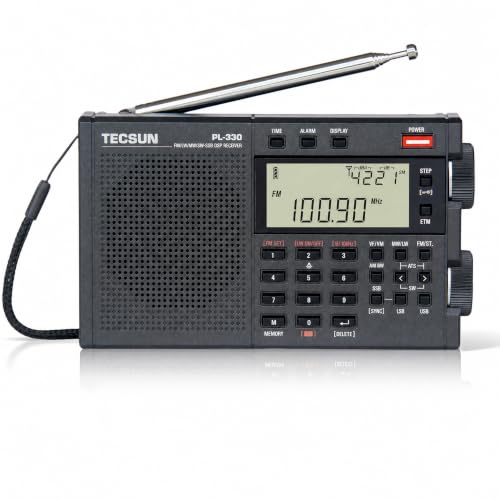
- A digital portable receiver with comprehensive radio frequency coverage including AM, FM, longwave…
- Adopts modern DSP digital demodulation technology as well as synchronized detection for enhanced and…
- A premium full-range 8 ohms / 250 mW speaker delivers loud, rich, crispy, dynamic and…
- Other convenient features include an alarm clock; a sleep timer of up to 120 minutes; external…
- Latest Updated Firmware Version 3307
Best for Travel: C.Crane CC Skywave SSB 2
At roughly 6 ounces and under 5 inches wide, the Skywave SSB 2 is built for a jacket pocket, not a shelf. It’s the only radio in this size class that adds VHF air band (118–136 MHz) and NOAA weather alert reception on top of AM/FM/shortwave/SSB, which makes it a genuinely useful multi-purpose travel radio rather than a shortwave-only device — relevant if you’re the type who also wants to monitor ATC or VOLMET on a trip. It ships with an SW wire antenna adapter, earbuds, and a case.
Trade-offs: you’re paying a real premium for the size — nearly 4x the PL-330’s price for comparable core shortwave performance. Speaker output is limited, as you’d expect at this size.
Good for: POTA trips, air travel, kayak/camping bags, anyone who wants one radio that also covers aviation and weather.
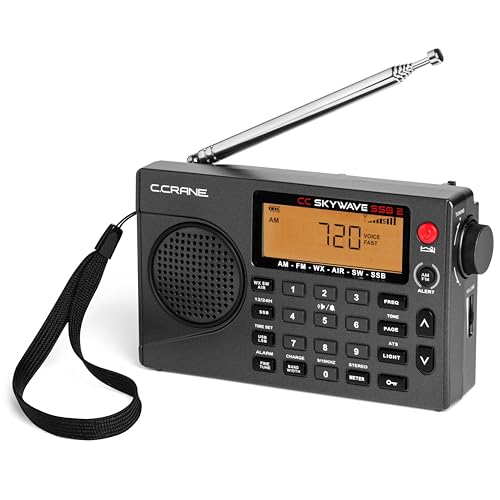
- One of the smallest multiband radios with Single Side Band. Full Range AM, FM, NOAA Weather band…
- Digitally tuned multiband receiver with superior sensitivity & selectivity enhanced by multiple…
- Direct frequency entry, auto scan and store, 400 memories. 10 aviation memories can be scanned for…
- Includes shortwave antenna jack that can significantly improve shortwave reception when used with an…
- Run Time (on batteries): approx 70 hours (earbuds), approx 60 Hours (built-in speaker). Runs on…
Best Value Under $150: Tecsun PL-880
The PL-880 is a step up from the PL-330 in sensitivity, audio quality, and tuning feel — multiple selectable bandwidths on both AM and SSB, and reviewers consistently note the tuning is smoother with less muting/chugging than lower-tier DSP sets. It’s roughly the size of a paperback book, still portable but clearly a step toward “serious receiver” territory.
Trade-offs: menu system has a learning curve, and it draws enough current during spectrum-display use that some rechargeable power banks trigger low-voltage cutoff prematurely — alkaline AAs (via adapter) or the internal 18650 are more reliable in the field.
Good for: listeners who’ve outgrown a budget set and want meaningfully better audio and tuning precision without jumping to flagship pricing.
- A digital portable receiver with comprehensive radio frequency coverage including AM, FM, longwave…
- Adopts modern DSP digital demodulation technology as well as synchronized detection for enhanced and…
- A premium full-range 8 ohms / 250 mW speaker delivers loud, rich, crispy, dynamic and…
- Other convenient features include an alarm clock; a sleep timer of up to 120 minutes; external…
- Latest Updated Firmware Version 3307
Best Premium: Sangean ATS-909X2
The 909X2 is what a lot of ham radio operators reach for when they want the closest thing to a desktop communications receiver in a portable shell. Sangean’s 5-level auto bandwidth control adjusts filtering automatically based on signal-to-noise ratio, and the DSP implementation avoids the slightly harsh, over-processed audio character some users report on Tecsun’s SSB reception. It runs on 4 AA batteries rather than a proprietary internal pack — a real advantage if you’re off-grid and want to carry spares instead of hunting for a charger.
Trade-offs: it’s the most expensive radio on this list, and it’s noticeably larger than anything else here — this isn’t a jacket-pocket radio.
Good for: serious DXers and ham monitors who want the best portable reception available and don’t mind the larger size, higher price, and AA-only power.

- Ideal Product
- Easy to use
- Durable product
Best Analog, No-Menu-Diving: Tecsun R-9700DX
Not every listener wants a menu system. The R-9700DX is an old-school analog-tuned receiver with a full lit dial and a sunken side tuning wheel — no DSP muting artifacts, no digital chuffing while scanning the band, just a smooth sweep across frequencies. Some experienced listeners specifically prefer this for late-night sessions where DSP “breathing” noise gets fatiguing.
Trade-offs: no SSB, so ham voice traffic and other SSB signals won’t demodulate cleanly. Tuning precision is lower than a digital set, and there’s no memory storage.
Good for: casual broadcast-band listening, nightstand use, and listeners who find DSP artifacts more annoying than helpful.
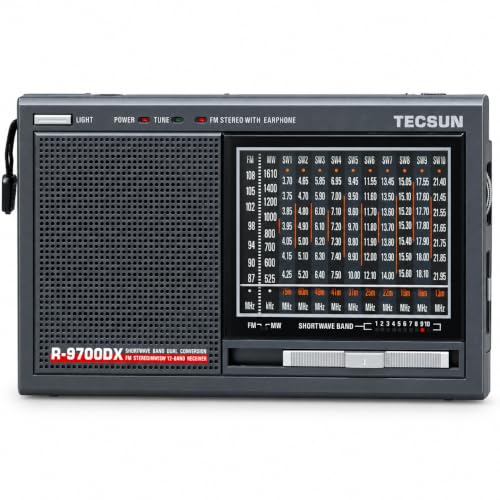
- 12-band AM/FM & shortwave worldband receiver
- Dual conversion with excellent sensitivity & selectivity
- Back-lit frequency display & built-in battery charger
- Includes shortwave antenna and AC adapter
- 1-year warranty
Best Grid-Down/Emergency Radio: Kaito KA500
The KA500 trades DXing refinement for a genuinely useful 5-way power system: hand crank, solar panel, AA batteries, USB, and AC adapter. It also includes NOAA weather alert channels and a flashlight/reading light, both of which matter more than reception sensitivity when the actual use case is “power is out and I need information.” It’s consistently one of the best-selling and best-reviewed radios in this category on Amazon.
Trade-offs: no SSB, and shortwave sensitivity is adequate rather than impressive — this isn’t a DXing radio, it’s a preparedness radio.
Good for: emergency kits, off-grid backup, anyone prioritizing reliability of power source over reception performance.

- 6-way powered portable emergency radio with hand crank generator, solar panel, compartment for 3 AA…
- Comprehensive coverage of AM, FM, 2-band shortwave and 7 pre-programmed NOAA weather channels for…
- Works as an emergency mobile battery charger with built-in standard DC 5V USB output port for…
- Telescopic antenna extends up to 14.5″ for high sensitivity reception assisted by advanced…
- Made of strong premium impact-resistant and water-resistant ABS material, suitable for both indoors…
Best Budget Without SSB: XHDATA D-808
The D-808 punches above its price with air band reception and RDS (station name/text display on FM) — features usually reserved for pricier sets. It’s a strong option for someone who wants broad band coverage and a rechargeable 18650 cell without committing to SSB-capable pricing.
Trade-offs: while some D-808 listings mention SSB, tuning finesse and stability on SSB is weaker than the Tecsun/Sangean sets above — treat it as a broadcast-band and utility listener first, SSB dabbler second.
Good for: budget buyers who want broad band coverage (including air band) without stepping up to a $150+ radio.

- 【FM/AM/SW/LW/Air Band/SSB】 Small portable FM/AM/Shortwave/LW full band radio with great…
- 【Many Functions with Large Display】[Alarm setting]: With the alarm clock you won’t miss your…
- 【Two types of power supply】High capacity replaceable battery operated radio and Type-C USB DC 5V…
- 【Good Sound Quality】Built-in speaker, external design is a large-caliber horn, the sound is…
- 【PRODUCT ACCESSORY】1 x specific bag 1 x external antenna 1 x USB charging cable 1 x English…
Frequently asked questions
Do I need SSB to enjoy shortwave listening?
No. International broadcasters transmit in plain AM, which any of these radios will pull in fine. SSB only matters if you specifically want to listen to ham radio voice traffic, maritime HF, or aviation HF — all of which transmit in SSB mode and sound garbled without it.
Will a portable radio work as well as a desktop/tabletop receiver?
Not quite, especially on weak-signal DX chasing, but the gap has narrowed a lot with DSP-based portables like the PL-880 and ATS-909X2. For casual-to-intermediate listening, a good portable is genuinely enough.
Does an external antenna really make a difference?
Yes — often the single biggest reception upgrade you can make, more than swapping radios. A cheap clip-on reel antenna extended out a window will usually outperform any stock telescoping whip on the lower shortwave bands.
Is shortwave listening legal?
Yes, in Canada, the U.S., and most countries. Regulations generally apply to transmitting, not receiving — you don’t need a license to listen.
Rechargeable vs. AA batteries — which is better?
AA-powered radios (Sangean, Kaito) are more field-flexible since you can carry spares anywhere. Rechargeable-cell radios (Tecsun’s BL-5C/18650 models) are more convenient day-to-day but need either a wall charger or a way to swap the cell if you’re off-grid for an extended stretch.
For the full picture on getting started — including antenna setup, propagation timing, and where to actually point your dial — see the complete Shortwave Radio Hub.
Related Radio-Hobbyist Articles:


